
Autistic people tend to have a very ambivalent relationship with sound. Some noises can be physically painful. Loud sounds can easily overload us, and processing speech when there's a lot of background chatter going on makes it almost impossible to filter out what's important. It's no wonder that we struggle at noisy social events. But as Abigail Balfe says in her wonderful book A Different Sort Of Normal, music can be always be relied upon to light my nervous system up like a Christmas tree.
I can still vividly remember the first piece of music that I heard and decided that I liked (and here, the Autistic version of "liked" means that I wanted to know everything about it: who played on it, how it was recorded, what instruments I was hearing, and why it didn't sound like anything else I had ever heard played on the radio; I needed the whole nine yards. I had to wait rather a long time for the Internet to be invented before I was able to satisfy much of that curiosity). The music was an instrumental by a British band called the Tornados called Telstar. It was written and produced by studio wizard Joe Meek and a fine bit of trivia about the piece is that the guitarist who played on it was George Bellamy, father of Matt Bellamy, the singer and guitarist in Muse. As it was released in 1962, I'd have been just two years old when I first heard it; it seems that good music has always made a big impression on me.
Other memories of music from early childhood involved listening to my father playing tapes on his mono Ferrograph 2N reel-to-reel tape recorder when I was six or so. I can still remember the complex smell of that machine, a combination of bakelite, overheating electrical components, hot oil, and the musty, slightly sweet aroma of magnetic tape. He used to record a bizarre selection of music from classical concerts to comedy sketches by The Goons or Victor Borge. Luckily, I had some hip relatives too: my cousin Janet and her friends would discuss the latest releases by the Beatles and the Rolling Stones and listen to Radio Caroline in her car, and my cousin Peter was the first person I knew to own a Pink Floyd LP.
My first revelatory moment, however, was listening to Tubular Bells for the first time and discovering that Mike Oldfield had played everything on the album (as well as doing most of the singing). Being able to do that myself immediately became a cherished dream and a significant (and if I'm going to be honest about it, my most important) life goal. It's one that I'm delighted to say I've achieved beyond all my expectations.
When I was a kid, there was a radio in the dining room. It was a lumpy brown thing built out of Bakelite which took several minutes to warm up before it would make any noise. Family listening usually took place during meals and consisted of shows like Two-Way Family Favourites or Sing Something Simple on the BBC. I loathed them. Even now, I can't listen to artists like the Mike Sammes Singers (and that name is etched into my brain for all time) without wincing at the overload of schmaltz. And yes, I know that they sang on Barry Gray's themes for Gerry Anderson's TV shows Supercar, Stingray, and The Secret Service but it doesn't make any difference. That genre of music just makes me shudder. How my cousins found out about all the cool bands they followed was a mystery; they never appeared on the stations that my parents tuned in to.
I had to suffer such broadcasts until my fourteenth birthday, when I was given a Nordmende Carrera De Luxe transistor radio that could even pick up short-wave transmissions. As far as I can remember, my father drove me from Stafford to a posh electrical goods shop in Stone so I could pick it up, and he didn't do things like that very often, believe me.
I absolutely loved that thing. I would listen to Radio One on it during the day and Radio Caroline at night; that was my favourite station, because it played music by the sort of groups that my friends and I all liked. Roaming the short wave bands in particular felt like I was exploring distant parts of the Universe, and I would often stay awake until much too late doing just that. It survived far longer than most of the other equipment from my teens and I still had it when I moved to this house back in the 90s. It sat on top of the fridge in the kitchen so I could listen to it while I did the cooking but sadly it expired a few years later; I really miss being able to roam the stranger frequencies out there, but the village is tucked away in a valley at the foot of the Cotswolds, and radio reception here is terrible.
At the age of eleven my family went to stay for a few days at my cousins' place near Chipperfield and they had a cassette recorder which we were allowed to record ourselves with and I don't think I had ever had so much fun before in my entire life. It was a Decca Legato and once I heard what they could do with it I became so obsessed with owning one of my own that I pestered my parents into buying one for me (dear reader, you have no idea just how focused I was on having one; they would have stood no chance at all of resisting me for long. I would have been relentless). It had to be exactly the same model, of course.
I still have a crate full of the cassettes from back then on which I recorded anything and everything I could. I'd stick a microphone in front of the TV to record the theme tunes of shows I liked; I'd record songs in the charts from the top 20 countdown on a Sunday evening, and my friends would make copies of their records for me if I liked them. When I got the Nordmende radio I mentioned above, I discovered that I could use the 5-pin DIN socket on the back of it as a line out and I no longer needed complete silence to get decent quality recordings; that was an absolute game-changer, particularly as it meant my brother Andy could no longer intentionally ruin recordings I was making by making silly noises just before they finished (he could—and still can—be a complete asshole when he put his mind to it).
I learned which cassette brands were reliable, and which should be avoided. I figured out that the optimum length of a cassette was the C90, which had forty-five minutes of space on each side, and I learned that the tape in C120s was so thin that it had a habit of stretching, which altered the pitch of recordings in an inconsistent and most unpleasant way. I listened to those tapes on a variety of increasingly expensive cassette decks, and would use them so much I would literally wear out the tape heads. When I finally learned to drive and bought a car, I would have a tape playing in it wherever I went. I wore the tape heads out on the players in my car, too.
Home taping didn't kill music. It sustained me.
I can still vividly remember my first experience with vinyl. It was also the first time I'd heard anything on headphones and the first time I'd ever heard a stereo recording.
I was at my friend Clive's house in Stafford. "Here, listen to this," he said, and plonked a pair of headphones over my ears. Then he dropped the stylus of his record player on the first track on side one of Led Zeppelin's second album, Led Zeppelin II. When Jimmy Page's guitar panned all the way from right to left for the first time during Whole Lotta Love I was so astonished that I fell out of my chair.
I knew instantly that my life was never going to be the same again. I needed to hear more stuff like that. Much more. All of it, in fact.
When I was twelve my father finally upgraded his 1960s valve setup and bought a turntable: a Thorens TD160 hooked up to a Salora Hi Fi Stereo 3000 amplifier. At last, I finally had a reason to start buying LPs of my own. Unfortunately to start with I often had to content myself with reading the sleeve notes rather than actually listening to the music; I wasn't allowed to touch my father's turntable at all and, as a profoundly overbearing control freak, if he didn't like what he heard, he'd take it off the deck and hand it back to me with the words "I'm not listening to that rubbish."
My father was a dick, ladies and gentlemen.
Eventually I somehow managed to acquire a second-hand record player of my own. It was a portable model which had a carrying handle on the side, a black plastic covering, and a silver front with a folding, latched lid. It was, I think, an SRPC31 that was made by Bush. I got a tremendous amount of use out of it for many years and I've been listening to LPs ever since on a series of increasingly expensive turntables.
I can still remember buying my first album. It was Emerson Lake and Palmer's Pictures at an Exhibition, which I bought at W H Smith's in Stafford. The revelatory experience I just mentioned, of listening to Mike Oldfield's classic Tubular Bells followed almost immediately afterward—but as I was living in the Midlands and it was the 1970s, most of the albums I subsequently bought featured heavy rock music in one form or another. Led Zeppelin, Black Sabbath, Yes and Pink Floyd were the bands at the top of the "albums to buy" list that I would obsessively rewrite every month or so as I discovered more records that I needed to add to my collection. I gradually became more and more focused on progressive rock, a.k.a. "prog" and ever since then the genre has been my first choice for listening (and, these days, also for playing). The blend of complexity, technical competence and big production values push all my muso buttons.
In case you're wondering: yes, I still have all my vinyl LPs, and I still listen to them. I have yet to investigate the delights of direct drive turntables, but I now have a belt drive Pro-Ject P2 that cost more than my first three record players combined, and it's been worth every penny. The process of putting a disc on the platter and brushing the dust off it is a ritual I will never tire of. It helps focus your attention on the music to come in a way that the trivial act of slotting a CD in a drive can never equal. Physically, too, the LP is such a glorious object. There's enough room on the sleeve to get a proper impression of the artwork rather than squinting at some tiny reproduction, and the gatefold sleeves for some double or treble albums have the size and heft befitting such extravagant musical endeavours. Hawkwind's albums were particularly impressive when unfolded, for instance. An LP wasn't just something to be listened to. It was a piece of art, something to treasure and cherish. Music is not something to be consumed; it's meant to be savoured, contemplated, and enjoyed. The packaging is an integral part of that experience. CDs just aren't the same, and as for downloads? Don't get me started.
But...
Having said all that, the astonishing experience of listening to a CD for the first time, with its complete absence of surface noise and a staggering increase in the dynamic range of what I was hearing was a pivotal moment. It was a recording of an album I thought I knew intimately: the fourth solo album by Peter Gabriel. Even though this was back at the beginning of the 1980s, I can still remember my single-word reaction when that immense bass note at the beginning of "The Rhythm of the Heat" came out of the speakers:
"Oh..."
My sonic world had changed forever, and I knew it.
As soon as I discovered what a compact disc sounded like, I started saving up to buy a player. I bought my first CD player back in early 1982. It was part of a gold Marantz system, the type that were known as midi systems even though they had nothing to do with the Musical Instrument Digital Interface system that we know and love today (it actually referred to the form factor of each unit). My Marantz system consisted of a stack of units that clipped together, one on top of another. A set of edge connectors at the rear top and bottom of each module kept cabling to a minimum and also reduced the risk of the stack getting knocked over. To my ears, it sounded great. As well as the CD54 compact disc player, it featured an AM/FM tuner, a cassette deck, an amplifier, and a turntable which rested somewhat precariously on the top for playing my LPs. While the other components were all pressed into service immediately, it was actually several months before I could afford to buy a compact disc to play on it. CDs back then were far more expensive than they are now. The asking price was somewhere north of £15 and it didn't drop for years. No wonder the 1980s were such a time of excesses in the music industry, because they must have been raking in the money.
The first two CDs I bought were The Turn of a Friendly Card by the Alan Parsons Project and The Golden Age of Wireless by Thomas Dolby. I wasn't exactly an early adopter, though. For the most part I continued to buy my music on vinyl and my CD collection remained in single figures for about a year. The fact that I could buy two or three vinyl LPs for the price of one CD meant that picking the digital version of a release was a pretty major deal. The process by which I decided which albums were worth buying on CD involved considerable research and the assessment of a bewildering and convoluted array of arcane criteria that I'd come up with; purchases depended not only who the artist was and how familiar I was with their work, but also on things like what sort of musical instruments were being played (and how loudly) and also on the technology which had been used to record—and mix—the album. In the 80s, CD sleeves had a three-letter code on them called the SPARS code, which indicated whether the methods used to record, mix, and master the album were analogue (denoted by an "A") or digital (denoted by a "D"). I had rapidly decided that the must-have CDs, in terms of sonic clarity, were the ones with a SPARS code of DDD. These days, of course, things aren't quite so clear cut, as I've heard tales from folk in the industry that more than one reissue of a classic album that was allegedly DDD had in fact being "mastered" not from the original studio tapes, but from an audio recording of someone playing a copy of the vinyl LP of the original release...
Most record shops didn't sell CDs at first. One record shop that did was just over the road from where I worked in Cheapside in London (which I think was called Harlequin Records). They had one of the largest selections I knew about and their stock probably ran to five or six hundred different titles, which sounds a paltry amount in these days of online retailers but back then, it was the sonic equivalent of Aladdin's cave. I can remember spending many lunchtimes there in the first half of the 1980s and I must have spent a fair proportion of my salary in there before I moved to Milton Keynes in 1986 and bought a house. There, the main music retailer was Sam Goody's, whose extortionate prices curtailed the rate at which I bought new discs even more effectively than my newly-acquired mortgage.
As prices came down, though, CDs gradually became my de facto medium for buying music. Even so, it took another seven or eight years for my vinyl habit to completely die off. That was when the Internet happened, online music retailers like play.com appeared, and the price of CDs dropped through the floor. It's fairly safe to say that I went nuts; my album collection ballooned and rapidly threatened to take over the living room. CDs are still my preferred medium for buying music and I now have several thousand of the things. Why? Because if a streaming service goes bust, so does your music collection.
The CD player on my Marantz system finally wore out and stopped working after nearly twenty years of heavy use. I was distraught; I had listened to thousands of hours of music with it. The rest of the system eventually followed suit but even though it was dead, I just couldn't bring myself to get rid of it. It's still languishing at the back of the loft somewhere and at some point I intend to find someone who knows what they're doing and can replace all its capacitors (which are almost certainly the elements that have failed) and return it to working order.
But the bright side of its loss was that it forced me to take the plunge and move to a proper, "separates" system. My timing was perfect: the Digital Versatile Disc format had just hit the market, so I chose a disc player that could play DVDs as well as CDs. After much consideration and interminable research, I bought a Denon surround sound amp (which I still have; it's currently plugged into my bedroom studio) and hooked everything up to my television. That began my tumble down the rabbit hole of home cinema technology and you can read all about that particular obsession of mine elsewhere on this site.
The first DVD player that I bought was a Panasonic. Not only could it play DVDs no matter which regional encoding was on them, it could also deal with more esoteric formats. As well as playing plain CDs on it, I explored the SACD format for a while. I liked the idea of surround sound mixes, but I soon decided that I could live without replacing the albums I already owned (with one or two notable exceptions like Pink Floyd's The Dark Side of the Moon. SACDs weren't cheap. Releases of the sort of albums that I was interested in were few and far between, too—to date, I have a grand total of just four albums in the format. It's probably just as well that SACD was a format that I chose not to adopt and these days it's been thoruoghly superseded by Atmos mixes on Blu-Ray (and those are much easier to find, too).
It was the same lack of availability that led me to make the decision not to bother with DVD-A discs. As they could be played on most standard DVD players, they became more popular than SACDs and there was a somewhat wider selection of titles available, but I can count the number of releases I have on DVD-A that weren't provided as extras with a standard CD release on the fingers of one hand. Almost all those standalone releases were recordings by Donald Fagen. Tracking his snapping fingers as they circle round the room at the beginning of the DVD-A release of Kamakiriad is a great piece of music to check that your surround system is working properly (and it's fun to use it to demonstrate to your friends what the experience of listening to music in 5.1 surround sound is like).
After being exposed to very loud music over the last forty years or so, perhaps it's no surprise that it's the multi-channel aspect of digital audio that appeals to me more than the increased definition and dynamic range of the recording. But even with my ears, I can hear a difference in what I'm listening to on a DVD-A or a Blu-Ray disc. And to explain what that means, please excuse me if I get technical for a paragraph or two...
The sound on a CD is played from a recording that was "sampled" 44,100 times every second, or 44.1 kHz. The sampling rate governs the frequency response of the recorded signal. Any audio which has a frequency of less than half the sampling rate (a frequency known as the Nyquist frequency) can be reproduced without distortion (known in the audio world as aliasing). The Nyquist frequency of a CD recording is, therefore, 22.05 kHz. This is above the highest frequency that the average adult human can hear. Indeed, the specific sample rate used was chosen in order to take that very fact into account. However, many audio interfaces used in recording studios can sample at much higher rates than this; even your computer's humble sound card is likely to be capable of running at 48 kHz at least, and it's not uncommon to find ones that run at 96 kHz or even 192 kHz. The MOTU audio interfaces that I use in my studio these days can sample audio at 44.1, 48, 88.2, 96, 176.4, or even 192 kHz.
Audio that is sampled digitally does not have a continuously varying range
of values like the signal on an analog LP does, though. Instead, it's
quantised into a number of discrete steps (and this is the basis for vinyl
aficionados claiming that the LP is a superior format to the CD). On a CD,
the audio is stored as 16-bit data, meaning that the value of the
amplitude of each sample is stored as a binary word that is 16
binary digits (bits) long. And that means that the range of values
for each sample runs in binary from 0000000000000000 (which is
0 in decimal) to 1111111111111111 (which is 216,
or 65,536 in decimal).
That's a big range of values, but it's not massive. Again, there's a lot of technology around that is used for recording audio at bit depths of 24 or even 32, which give a range of values of 224 or 16,777,216 and 232 or 4,294,967,296 respectively.
The MOTU 828 and M4 that I use as my audio interfaces these days both have 32-bit/192 kHz ESS Sabre32 DAC chips in them. That's quite an improvement in resolution over what is required for achieving CD quality recordings. Understandably, the audio files you get when you record at that resolution are significantly larger, which is why the Blu-Ray format is better suited to high definition audio releases than CDs are. Where a CD holds around 700 Mb, a dual-layer Blu-Ray disc can store 50 Gb of data. All that extra data pays off: for every bit you add to the binary word storing a sample, you get a 6 dB increase in the dynamic range of the signal that's being recorded. That's a lot.
The dynamic range of a playback system is always split into two parts:
- Its signal to noise ratio, which indicates how much louder the recorded signal is when it's compared to the background noise that is generated by the system itself—remember that I mentioned an LP's surface noise when I talked about that Peter Gabriel album just now?
- Its headroom, or how much louder the signal can get above a nominal value (on CDs this is defined as -14 Loudness Units Full Scale or LUFS) before it starts distorting, or clipping.
The dynamic range of a vinyl record comes in at around 70 dB, and a CD has a maximum theoretical dynamic range of 96 dB. That sounded pretty darn good to me when I first heard a CD, and it still is. That's as good as anyone really needs, right?
Well, up until the point where I first heard a DVD-A disc, I'd probably have agreed with you. Afterwards, not so much: the maximum theoretical dynamic range of a DVD-A disc is 144 dB. Believe me, that makes an absolutely jaw-dropping difference.

I must admit I get a kick out of seeing my surround sound amp telling me that it's reproducing audio at 96 kHz, with 24-bit encoding.
The highest-quality commercial recordings I own are on Blu-Ray. The Atmos mix on my 50th Anniversary copy of Dark Side Of The Moon has been mastered at 96 kHz/24-bit, but it also has a DTS-HD stereo mix that's 192 kHz/24-bit. Ken Scott's 2024 Atmos mix of Ziggy Stardust has the original 1972 stereo mix of the album at the same resolution. Other high definition recordings in my collection include a remastered version of Rush's breakthrough album Moving Pictures (which I'm sorry to report has since succumbed to the dreaded disc rot) as well as several King Crimson and Robert Fripp albums. The Crimson box sets are glorious things. Each of them contains on the order of twenty discs (and Robert Fripp's Exposures set has more than thirty!) which address a two- or three-year phase of the band's fifty-year recording career, addressing two or three albums and does so in prodigious, forensic detail. The albums are presented in multiple formats which include 5.1 surround sound mixes together with studio outtakes, videos of live performances, and much more besides.

Yes, all of those speakers are in use, because I have a 7.1.4 setup these days. Prince's album Purple Rain sounds amazing in this format. Quite frankly as a kid who started off listening to albums in mono through a single, tiny little speaker, this all seems a bit ludicrous at times.
As I said, I can hear the difference even with my rather elderly and very well-used ears. The recordings are more finely detailed and the increased signal to noise ratio and greater headroom is readily apparent. Which is odd, because the human ear shouldn't be able to tell that there is anything missing from the audio as it's presented on a CD. Our ears can't hear frequencies above 20 kHz, well below a CD's Nyquist frequency. But psychoacoustics is a strange thing, and a recent meta-analysis by Joshua Reiss found that people really can tell the difference.
However, "hearing a difference" is most emphatically not the same as "hearing an improvement". Audio amplifiers distort more readily when they're fed signals they're not designed to reproduce such as ultrasonics, and as this blog points out in detail, music that's encoded at higher frequencies allows much more of those nasty, distortion-making signals to wreak havoc with your amplifier. Even the increased dynamic range is, in most cases, pure overkill and completely unnecessary. The verdict in the blog is that those 24-bit/192kHz recordings sound worse than CDs, and each file takes up six times the space.
As things stand, I'm not ready to move away from the CD format completely. For one thing, I've invested heavily in the format, with a collection of around 3000 discs. For another, I'm not a fan of digital file compression when it's applied to music. I find low bitrate mp3 files ugly and painful to listen to, particularly if there are cymbals in the mix—high frequencies don't survive lossy file compression in any shape or form that's easy on the ears. The results are nasty. I don't really do the downloads thing unless there is absolutely no other way of getting the particular piece of music I'm looking for, or I can get a CD of the same album at the same time.
Even though I like to hear the music I'm listening to properly, I wouldn't class myself as an audiophile. I don't keep swapping out components in the quest for that perfect sound—far from it: I refresh my audio system once every twenty years or so. When I do decide it's time to upgrade, it's usually because something breaks. I'm not keen on adopting new formats when they're introduced; it took me fourteen years to buy an amp that could decode the DTS Master Audio data on Blu-Ray film, for example. When I do buy stuff, I buy equipment that's going to last.
The key to any system is the speakers, and way back at the turn of the century I spent a long time going round lots of different audio stores, auditioning different brands connected to amps in all shapes and sizes before I picked the setup that I've got now: a pair of B&W DM 602 series 2s for the left and right channels, 601s for the surround channels, a CC6 for the centre, and a Paradigm PDR10 for the sub. Twenty years later, the resulting sound is still excellent, even if I've had to replace the driver in the subwoofer after the polyurethane foam gaiter connecting the original speaker cone to its chassis rotted away into a nasty black goo; audio equipment does not last forever. I was able to pick up a replacement driver (with a significantly better specification than the original) for under £40 and managed to install it in the cabinet myself without any difficulty at all. Once it had bedded in (new loudspeakers take time to settle down) the degree to which it beefed up the low end of my system was astonishing. I needed that extra grunt, too; the surround sound amp that I use for listening to music and watching movies can handle all the current audio formats including Dolby Atmos, which is a true three-dimensional sound recording format. And yes, after caving in and buying an additional power amp to handle the last two channels, I now have seven surround speakers at ear level, a subwoofer on the floor, and four presence speakers up by the ceiling to give me the full 7.1.4 Dolby Atmos immersive audio experience in my living room. And my single-word response when I heard that for the first time?
"Whoa!"
Once I'd hooked my NICAM stereo VCR up to my audio system, watching anything on television in mono was clearly no longer acceptable. But I was happy with the setup I had at that point, right up until I heard a DVD through a mate's surround sound system.
DVDs brought proper multichannel surround sound—the sort that I'd only ever experienced at the cinema—to the mainstream consumer market. For a music nerd like me, the soundtrack to a film is a significant portion of the overall experience. So when someone invites you round to their house to hear the audio visual receiver which they've just bought that decodes the soundtrack on the disc and throws it at you from speakers dotted all around their living room, you're likely to be in for a bit of a shock. Suddenly, feeding the audio out of my VHS recorder into my stereo system was no longer quite as radical or impressive as it used to be. Nerd that I was, this new sonic experience was something I had to have.
Unfortunately, getting the full surround experience meant completely updating my home audio system.
All of it.
I got bitten by the DVD bug pretty badly. No, that's an understatement; the invention of the DVD turned my existing fascination with audio into outright obsession. And because I'm me, I don't do things by halves. I didn't just have to replace my stereo speakers, I had to buy new ones for all of the additional channels, too. And getting an audio visual receiver with full surround sound capabilities wasn't cheap either.
Why did getting one matter so much to me?
Because when you hear something in surround sound, whether it be Dolby 5.1, DTS, DTS-ES DSCRT, DTS-HD, THX Cinema or Dolby Atmos, which all route the film's sound to multiple speakers as well as one or more subwoofer tracks (that's what the ".1" or ".2" means) you're hearing audio that's recorded using a far greater dynamic range than you can get on a CD. Once you've experienced that, you soon start thinking that the NICAM stereo setup you have, which used to be the bees' knees in terms of audio visual sound quality, suddenly sounds boring—and worse, pathetically thin. So it goes; that's how technology propagates. Shiny!
The first AV receiver that I bought for my brand spanking new Panasonic DVD player (and it was a multi-region one, naturally) was a Denon AVR-3801, which lasted me 19 years and pumped out 105 Watts into a total of eight separate channels (because I'd gone for a system that didn't just play back 5.1 surround, it could also reproduce the brand-new 7.1 format as well). It provided a great sound experience and it's still hooked up to a set of speakers in my home recording studio so I can check my mixes on a decent hi-fi setup as well as through my near-field monitors.
The thing is, technology does not stand still. It wasn't long before the Denon lacked a lot of features that had appeared on the market. It couldn't make sense of the Dolby Pro Logic II format which came out the following summer, for example (this improved on the original Pro Logic by splitting the rear channel into left rear and right rear channels, giving the listener five separate sources of surround sound from a normal stereo signal). When Denon brought out the AVR-3802 the following year, it had Dolby Pro Logic II decoding on its list of new features. It would have been nice to have, for sure. But I just shrugged my shoulders and stuck with what I had, because I had recognised that shelling out for the upgrade would start me down the true audiophile rabbit hole, and I wasn't earning the sort of salary which would allow me to indulge myself like that; I simply couldn't afford to continually upgrade my gear to stay up to date. And part of me viewed the breathless gumph about the difference that things like "high quality oxygen-free interconnects" amade to the listening experience with more than a little bit of cynicism.
Audio improvements didn't stop at Pro Logic II. Truly lossless surround sound arrived when DTS-HD Master Audio was announced in 2004, a couple of years before Blu-Ray (the format that has made it ubiquitous) was launched, but my Denon receiver could only decode sound that used that codec into the older, lossy (and therefore inferior) DTS audio. Even this didn't bother me too much because I wouldn't get round to buying a Blu-Ray player until 2008 once the HD format war had been settled.
My experience in replacing the Denon didn't go particularly smoothly. In fact I ended up returning the first AV receiver I'd chosen, which was the most expensive one in Onkyo's range. It couldn't lock on to the signal it was getting from my DVD player no matter what I did (which was a big surprise, because it had got great reviews). I ended up taking it back to Richer Sounds and asking their technical guy what system he had at home, and bought one of those instead. The Yamaha was nearly a thousand quid cheaper than the Onkyo but it worked perfectly with the same player. It's proved to be a reliable workhorse ever since and it sounds great; there's a lesson to be learned, there.
When I got my new receiver out of the box, I realised exactly how far home audio technology has come because the new amp came with a cute little microphone and a stand. Plugging the mic into the receiver initialised the receiver's Yamaha Parametric room Acoustic Optimisation or YPAO function. Telling it to proceed resulted in it playing test tones through each speaker so that it could balance speaker levels and adjust the eq to fit the properties of the room and avoid creating standing waves in the bass frequencies that would distort the subwoofer response. The receiver also has a WiFi antenna, so it can connect to the Internet and download firmware updates or stream music from online sources.
And while we're on the subject of the Internet, I never thought I'd be using Internet radio before I bought the receiver but once I realised I'd bought a device that lets me listen to stations from anywhere on the planet (provided that Yamaha's service provider has got everything working, which is not always the case) I've become a big fan.
The receiver also has a DAB/FM tuner, rather than an AM/FM one (which is a very welcome change, and one that's long overdue—I think the last time I listened to anything on AM radio was at least fifteen years ago). As I mentioned earlier, radio reception here is terrible, so of course I also ended up buying myself a better aerial for the radio than the long thin piece of wire that such systems are normally supplied with; that made a huge difference to how many stations it could pick up.
And the Yamaha has a ridiculous number of HDMI sockets for interconnects; I was amazed to discover that HDMI cables these days not only have the capacity to carry 4K video at 60 frames a second, they can also have a bigger data bandwidth than the optical cables I used to use with the Denon. I thought optical interconnects were the ultimate; how wrong I was. Now I use HDMI for everything I can!
The most noticeable advance in technology that the Yamaha delivers is due to a profound shift in how multi-channel audio is delivered to the listener. With a massive increase in the sheer amount of computational power that it's possible to cram inside a home cinema receiver these days, new sound codecs have been introduced that are object-based. This means that each individual sound is stored separately on the disc together with metadata that tells the receiver exactly where in the room it should be placed (and how it should move). It doesn't matter whether the sound is a voice, an instrument, or a sound effect—the receiver will place each discrete noise at a specific point in the available sound field. My Yamaha amp uses the industry standard format to do this: Dolby Atmos. If you've heard a decent 7.1 "surround sound" system in action and been blown away by it (as I was way back at the turn of the century when I first installed a home system that could play it) wait until you hear Atmos.
Adding four presence speakers up near (or in) the ceiling takes you from 7.1 to 7.1.4. This creates a sound field arranged in three dimensions rather than two in order to generate what's known as "immersive audio." And believe me, it does exactly what it says on the tin. I thought I was absolutely fine doing without this until 2024, when I spent a few days at Peter Gabriel's Real World recording studio near Bath and heard what the format sounded like on a proper (and oh boy, do I mean proper) Atmos setup. I'd upgraded my system to add front and rear presence speakers within a couple of weeks of getting back home, and I have not regretted doing so for one second.
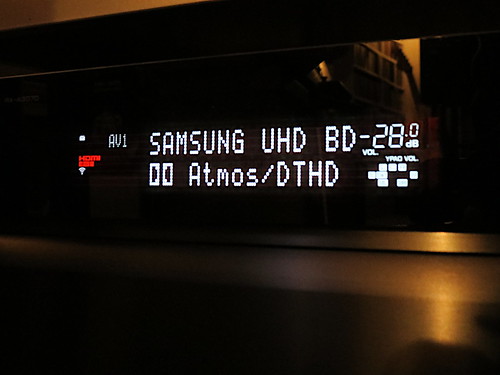
I love this.
I ran the YPAO routine again when I fitted the presence speakers and this time I asked the function to calculate speaker angles and heights as well (that's what the stand which came with the YPAO microphone is for). The amp now knows exactly where to put each sound because after it's listened to how the room responds during the system's calibration process, it knows what shape the room is, how far each speaker is from my listening position, what the room's resonant frequencies are, and whether each speaker is above or below ear height. After running the YPAO program this time I could hear a noticeable improvement in how focused the resulting sound field had become, because I can now point my finger at the exact spot where an individual sound is coming from, rather than just waving my hand in the general direction of its origin. For someone who spent more than thirty years just listening to stuff in stereo, it's an uncanny experience.
If you've been reading all this and wondering if I've been writing in some weird alien language because you have no idea what I'm on about, count yourself lucky—if you did know, you'd probably be either on the verge of spending a considerable amount of money getting the same sort of system, or you'd already have done so. But take it from me, speaking as an enthusiast who has watched and listened to thousands of films over a surround system, that it makes a profound difference to your home cinema experience.
When I buy new components, I want stuff to last; I normally plan on keeping a purchase for twenty years, so before I buy anything there's always a lot of research involved. I read lots of magazine and website reviews and there is much comparing of specifications. Although I like to hear high-quality sound, I wouldn't call myself an audiophile. My friends would probably disagree with this but I know people who have spent more on a pair of loudspeakers than I've spent on my entire setup.
When I do upgrade my system—which only happens every twenty years or so—it's normally because I've become too frustrated with the shortcomings of what I've currently got. Even when I could play Blu-Ray discs, I kept my original Denon receiver. It was only when it started to struggle with the signals I was feeding it (to the point where it was refusing to play any sound at all on some of the films I'd bought) I decided it was probably time to replace it.
Right now, there's nothing about my current system that I'm not happy with. Being able to listen to a Dolby Atmos immersive audio mix in the living room is something that was beyond my wildest dreams ten years ago. Some shiny new piece of technology might arrive tomorrow and change things, of course. But for the moment I'm more than content with my home audio experience.